

Form 1-765 Explained in this Complete Guide

15 Aug. 2022
Form 1-765 Explained in this Complete Guide
If you’re in the US on a visa that doesn’t explicitly allow you to work. You’ll almost certainly need to fill out and submit Form I-765, Application for Employment Authorization. The Form 1-765 is explained in detail in this article.
This form allows you to petition the United States government for permission to work, regardless of the type of visa you have.
Foreign-born people or foreign students with the right to live in the United States do not have the ability to work unless they first apply for and obtain employment authorization document (EAD), commonly known as a “work permit.”
What exactly is Form I-765?
Form I-765 is a request for an Employment Authorization Document (EAD), also known as a work permit.
An EAD may be obtained while your green card application is being processed.
This enables green card holder to work legally before becoming lawful permanent residents.
Once your EAD application is granted, you will receive an identification card that you can use to apply for a Social Security number and find work.
If you previously filed this form but have now lost or need to renew your EAD. You must additionally file form I-765.
Who is eligible to file Form I-765 or Employment Authorization Document?
In general, the following groups are eligible to apply for work permits:
- Applicants for adjustment of status who have a pending I-485
- People given asylum and refugees
- Individuals who have been granted deferred enforced departure (DED) or temporary protected status (TPS)
- Students on F-1 visas (with various limitations)
- J-2 spouses or minor children
- M-1 students who seek practical training after completing their education.
- Nonimmigrant K-1 fiancé(e) of a US citizen or K-4 children
- L-2, T-1, T-2, T-3, T-4, or U-1, U-2, U-3, U-4, U-5, V-1, V-2, or V-3 visa holders
- While waiting for their adjustment of status applications, family and marriage -based green card applicants can apply for work permits.
Certain family member of US citizens and permanent residents, however, can still apply for work authorization even if they haven’t applied for a green card. They are as follows:
- A fiancé(e) of a US citizen may apply for work permit if they do so within 90 days after entering the US on a fiancé(e) (K-1) visa.
- Even if they are on a K-3 nonimmigrant spousal visa, a spouse of a US citizen can seek for work permit.
- Individuals who meet the requirements for the Family Unit and the LIFE Family Unity program.
However, if you’re applying via marriage to a person who already has a green card. You’ll have to hold off on applying for a work permit until a visa number becomes available.
Who should not apply for I-765 form?
You should not apply for this form if you fit into any of the following three categories:
- A lawful permanent resident
- Conditional permanent resident
- Non-immigrant with a specific work permit via form 8 CFR 274a.12 (b). These are foreign nationals who are permitted to work in the US, but exclusively for a certain company.
How much does it cost to file Form I-765?
The filing fee for submitting Form I-765 separately is $410.
For a total of $495, you must also pay an additional $85 biometric services cost.
Some applicant categories may be exempt from having to pay these costs.
For instance, those seeking work permits for the first time as refugees or asylees are not required to pay filing fees.
Noncitizens who received a withholding of removal order are not required to pay any fees for the Form I-765.
Fees may be paid by:
- Money orders
- Using Form G-1450, Authorization for Credit Card Transactions
- You can pay using a cashier’s check or a credit card
Who is not required to pay the filling fees?
If your work permit application is submitted in the same package as your Adjustment of Status (AOS) green card application, there is no charge (as long as your Form I-485 was filed after July 30, 2007).
Fee Waivers
By submitting Form I-912 (Request for Fee Waiver) along with your Form I-765 and all necessary supporting documents, you can ask for a fee waiver if you are unable to pay the filing fee.
If accepted, the filing fee and the biometrics charge will both be waived, so you won’t have to pay anything.
Form I-765 Processing Times
Getting an EAD is easier and faster than getting a visa or green card. The processing time for I-765 is approximately 6 months, though this may vary depending on the service center.
Form I-765 is typically processed in 150-210 days (5-7 months) by the government agency US Citizenship and Immigration Services (USCIS). Previously, work permit applications were handled within 90 days, but a mounting backlog has created additional delays.
How to apply for Form I-765?
You can file Form I-765 with your green card application (Form I-485) or at any time after you’ve received notification from US Citizenship and Immigration Services that your green card application has been received. You just need to attach a completed Form I-765 and two passport-sized photos if you apply for a work permit in the same package as your green card application.
Check out Green Card Processing Steps to learn more about how to obtain a Green Card.
Even if you’ve already submitted your green card application, you can still apply for a work permit by submitting Form I-765 along with a copy of the USCIS notice receipt of your green card application (including the I-485 filing fee).
Be certain you follow the Form I-765 filing requirements exactly. According to US Citizenship and Immigration Services, I-765 petitioners must file their application with the service center that will process their petition. Previously, applicants would send their applications to a single service center hub, which would then route them to a different location for processing.
Note: If you are filing the I-765 along with another form, such as the I-485, make sure to send both forms to the service center address indicated on the other form.
Documents required for applying Form I-765
Form I-765 requires the following documents:
- If possible, a copy of your I-94 travel record (front and back), or a printout of your electronic I-94 acquired from US Customs and Border Protection (CBP)
- A photocopy of your US visa (a document placed in your passport)
- Your passport photo page copies
- If applicable, copies of previous work permits (front and back)
- Two recent 2-inch-by-2-inch passport-style photographs of yourself (print your full name and Alien Registration Number on the back of each with a pencil or felt-tip pen)
- Copy of marriage based green card
A copy of the USCIS receipt notification (official acknowledgment letter) indicating that your green card application (Form I-485) is pending, but only if:
- Your sponsor has a green card
- Your sponsor is a citizen of the United States, and you are seeking for a work permit after filing your green card application (which would be unusual)
If you have never had a work permit, you must also provide a copy of one of the following types of government identification:
- A birth certificate and a photo ID are required
- A copy of a visa (a document placed in your passport) issued by a consulate other than the United States
- Other national identification document with your photo and/or fingerprint
How to fill out Form I -765?
There are a few general guidelines for completing Form I-765.
- If possible, type the information into the form.
- Otherwise, print it out and fill in the blanks with black ink.
- Instead of leaving a space blank, USCIS wants you to type “None” or “N/A” (for “not applicable”).
- If your response does not fit in the area provided, utilize Part 6 of the form to provide additional information.
Part 1: Reason for Applying
- Check 1.a, “Initial permission to accept employment,” if this is your first work permit.
- Checkbox 1.c for renewal if you’ve previously applied for a work permit (for example, if you’re applying now as part of your green card application but previously applied for and received a work permit as a fiancé(e)).
- Tick 1.b if you are applying to replace an employment authorization document that has been destroyed, stolen, or lost.
- The only criterion is that the damage or missing employment authorization document was not caused by USCIS.
- A new form I-765 and filing fee are not required to replace an employment authorization document owing to a USCIS error.
Part 2: Personal Information
The majority of this section is self-explanatory except for the following:
Question 8: Do you have an Alien Registration Number (A-number) and/or an I-94 number?
If you applied for any immigration benefit after arriving in the United States or were placed in removal (deportation) proceedings, you were assigned an A-number.
Analyze any correspondence you received from a US immigration office for your A-number (the letter A followed by 8 or 9 digits).
Question 9: You might possess a USCIS Online Account Number or not. You would only have one if you enrolled for this system and submitted an online application.
Question 13a and 13.b: Check “yes” and then provide your Social Security Number (SSN) from the Social Security Administration (SSA), if you have a valid Social Security Number. Otherwise, mark 13.a as “no.”
How to Use Form I-765 to Apply for a Social Security Number?
Questions 14-17:
If you require a Social Security Number (SSN), you can avoid going to the Social Security Administration (SSA) office by answering these questions.
By answering “yes” to questions 14 and 15, and supplying some personal information about your parents, the SSA will assign you a number and send you your card shortly after you acquire your work permit.
Question 21:
If you entered the United States legally, you should have an I-94, either in paper form or on the CBP website if you arrived by plane or ship after April 2013. (Your passport number will be required.)
If you arrived before 2013, or crossed a land border, you may have found a white I-94 card stapled in your passport.
Your I-94 was included with your approval notice if you changed status within the United States.
If you have more than one I-94 number, always use the most recent one. If you arrived without documents or as a Canadian tourist, you will not be issued an I-94 number.
You can find your electronic I-94 record on the website of US Customs and Border Protection (CBP): I-94 record
Questions 22 and 23:
If you arrived in the United States by plane, you must identify the date and airport where your plane landed – where you were inspected by a U.S. border officer.
In case you entered the United States after April 2013, you can view your trip history on the website of the United States Customs and Border Protection (CBP): History of Travel
If you crossed a land border without being inspected and you know you entered a specific border city (such as El Paso, Texas, or San Ysidro, California), include that information as well.
Questions 24 and 25:
Ask about your immigration status in the United States at the time of your arrival and at the present moment. You can utilize the visa category letters and numbers if you know them (such as B-2 for visitor or F-1 for academic student).
Your visa category can be found on your I-94 record.
Alternatively, describe your category (for example, “visitor” or “student”). If you are not lawfully present in the United States, put “no legal status”.
Question 27:
You must read through the first few pages of the USCIS Form I-765 instructions until you identify your eligibility category.
If you are applying for adjustment of status, you would fall under the category “(c)(9)”.
Alternatively, if your category is “F-1 Student Seeking Off-Campus Employment Due to Severe Economic Hardship,” you would write “(c)(3)(iii)”.
If your category only includes two letters/numbers (like (c)(9)), fill in the parentheses on the far left and leave the parenthesis on the far right blank.
Consult an immigration lawyer if you need assistance defining your category.
Additionally, certain applicants will be asked to provide extra information in the questions below.
In Part 3, near the bottom of the form, you must include your signature, the date, and contact information.
The rest of the form must be completed and signed by an interpreter, immigration attorney, law firm, or any individuals you engaged to assist you in preparing your form.
Question 29:
To determine your eligibility category, consult the I-765 instructions (also available on the USCIS website).
Some of the most prevalent categories are:
- Persons granted asylum fall into categories (a)(5).
- People having Temporary Protected Status (TPS) are classified under category (a)(12).
- Category (c)(3)(C) for students pursuing optional post-completion practical training.
- J-2 spouses of J-1 exchange visitors are eligible for Category (c)(5), and anyone with a pending adjustment of status application is eligible for Category (c)(9).
- If your category just includes two letters or numbers (for example, (c)(9)), simply put the “c” in the second set of parentheses and the “9” in the third.
Attaching Proof of Your Work Permit Eligibility categories
To demonstrate your eligibility for a work permit. Produce a photocopy of whatever document demonstrates your status as indicated in Question 29.
For instance, if you apply as an asylee, attach a copy of the asylum office letter or judge’s order granting you refuge.
The Form I-765 instructions specify the documents you must submit.
However, if you apply for the work permit concurrently with an application for a status, such as adjustment of status or TPS, you do not need to include proof of eligibility.
Your eligibility for the application you filed will be reviewed by USCIS.
How to file Form I-765 for OPT Students?
F-1 students in the United States may file for EAD: Application for Employment Authorization with the United States Citizenship and Immigration Services (USCIS) to request specific employment authorizations and obtain an Employment Authorization Document (EAD) or Work Authorization document.
The United States Citizenship and Immigration Services (USCIS) is the government agency within the Department of Homeland Security (DHS) in charge of lawful immigration to the United States. They will examine your I-765 application and issue you your OPT EAD card.
If you are applying for Pre Completion OPT or Post Completion OPT : USCIS must approve your I-765 application and you must have your EAD card before you can start working. Furthermore, you cannot start working until the start date listed on your EAD card.
If you are applying for a 24-Month STEM OPT Extension Application : If you have an I-765 application pending with USCIS, you can continue working for up to 180 days after your current Post-Completion OPT EAD expires.
When should you submit your I-765 application to the United States Citizenship and Immigration Services ?
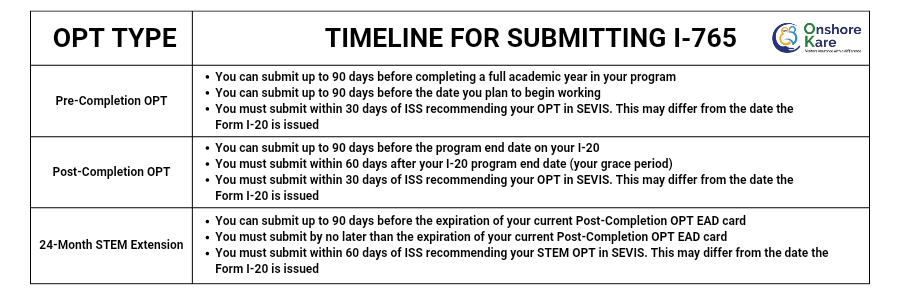
Filling of Form I-765 online for OPT Students
Online filing allows applicants to:
- Submit forms electronically
- Pay fees
- Track the status of their case at any time and from any location.
- Instead of waiting for USCIS notices from the service center in the mailing address, receive them online.
- Use a secure inbox to communicate with USCIS.
- Respond to Evidence Requests (RFEs).
Documents Required
- OPT or STEM OPT I-20 issued by ISS
- I-797 Status Change or Copy of I-94 Notice of Approval
- Front and back copies of previous EAD cards (if applicable)This is required for applicants seeking a 24-month STEM OPT Extension.
If you have never had an EAD card, you must submit a copy of your passport.
- A recent color passport-style photograph.
Note: Depending on your specific situation, additional documents may be required. Read the instructions carefully to see if you need to upload any additional documents.
Eligibility Criteria
Choose your eligibility category:
- (c) (3) (A) : Pre-Completion OPT
- (c) (3) (B) : Post-Completion OPT
- (c) (3) (C) : 24 months STEM OPT Extension.Note: The USCIS website has a full, comprehensive list of the specific documents they want from you based on your eligibility category or immigration status. For example, F-1 students will need to provide evidence of full-time enrollment, their Form I-20, SEVIS ID number, and OPT authorization.
Reason for Applying
- Select “Initial permission to accept employment” for pre and post-completion OPT applicants.
- Applicants for 24-month STEM OPT Extensions can usually select “Renewal of permission to accept employment.”
Have you ever filed Form I-765?
If you have previously received an EAD card in the United States, select “Yes”.
- All STEM OPT Extension applicants must choose “Yes”.
- Otherwise, choose “No”.
What happens after submitting Form I-765?
If you filed the I-765 online:
- You will receive a receipt notice with your receipt number immediately after submitting the application (typically a number starting with IOE).
- In addition, you will receive a paper I-797 receipt notice in the mailing address.
- You can access your USCIS account to check the status of your application.
- If you receive a Request for Evidence (RFE), you can respond via your USCIS account.
- Contact ISS as soon as possible if you require assistance in responding to an RFE.
- The final decision on your I-765 application should be sent to you via your USCIS account (approval or denial).
If you mailed your I-765 application:
- Check to see if the I-765 application has been delivered to the respective service center.
- Check the tracking system of the United States Postal Service to see if the OPT application was delivered to the concerned service center. More information about tracking the delivery of your EAD card is available from USCIS.
- A paper I-797 receipt notice will be mailed to you. This notice will include your receipt number.
- To check the status of your application, enter the receipt number into the USCIS Case Status Online tool.
Frequently Asked Questions
What Happens Once I-765 Is approved?
If USCIS approves your application, you will receive two documents: your Employment Authorization Document (EAD), also known as the “USCIS I-766 card” or “work permit,” and your Social Security Number card in a separate envelope (if you applied for one).
Your EAD and Social Security card will be mailed to the physical address you provided on your I-765
How long is the EAD valid?
The length of your work permit is determined by your current immigration status or the type of visa you have. The majority of EADs are valid for 1-2 years.
When my green card application is approved, what happens to my work permit?
When you receive your green card, your work permit expires. You will not require a separate work permit as a permanent resident.
What Does I-765 Approval Indicate?
You will be granted employment authorization if your Form I-765 is approved. Even if your current visa is not a worker visa, your employment authorization allows you to legally work in the United States. You’ll be given an employment authorization document in the form of a card with your photo and an expiration date. You can show that card to your employer to demonstrate that you are legally permitted to work in the United States.
Can an attorney file Form I-765 on your behalf?
Your immigration lawyer/law firm can absolutely file Form I-765 on your behalf. If you had your immigration attorney file this form on your behalf, you will provide supporting documentation as needed. Then you and your attorney can check the status of your petition.
What Happens When You Work Without Authorization?
In general, anyone who is not a green card holder or a U.S. citizen (except those on a work visa) must show an employer that they have a government-issued Work Authorization Document.
Employers are not permitted to hire individuals who do not possess this document.
If you work without a permit, you may face legal consequences. In fact, you may be denied a green card, or worse, you may be barred from entering the United States for up to ten years.
What Happens If You Do Not Apply for or Receive a Social Security Number?
If you did not request an SSN card on your I-765 application or did not receive your SSN by mail, you must go to a Social Security Administration (SSA) office after receiving your specific Employment Authorization Document (Form I-766) from USCIS service center to apply for your Social Security number and card.
When visiting an SSA office to apply for a Social Security card, bring the following original documents with you (photocopies or notarized documents are not accepted):
- Your Form I-766 to demonstrate your immigration category and ability to work in the United States.
- Your birth certificate will serve as proof of your age. If you do not have a birth certificate or cannot obtain one within 10 business days, the agency may accept a foreign passport, United States military record, or religious record that shows your age or date of birth.
- After submitting your application, you should receive your SSN card within 2 weeks.
Is it possible that my work permit will be denied?
Your work permit may be denied for the following reasons:
- If you omitted a required element or filled out the work permit application form (I-765) incorrectly. This could happen if you applied for a work permit after submitting your green card application and did not include a copy of the original USCIS receipt notice.
- If your green card application is processed quickly enough that you have an approved green card before your work permit application is completed.
- If you applied for a work permit earlier than the deadline (for example, asylum applicants need to wait 150 days before they can apply for work permit).
How can I get my work permit renewed?
- You can apply for a renewal work permit as early as 6 months before your current one expires.
- You must file another Form I-765 with supporting documents to renew your work permit.
- A copy of your current work permit and two passport-sized photos are also required.
- Work permit renewal can take up to 150 days to complete.
How do I apply for a replacement EAD?
- To request a replacement EAD for lost, stolen, or destroyed documents, follow the renewal process outlined above.
- If your EAD contains incorrect information that is not the result of a USCIS error, you must submit a new I-765 form, a filing fee, the necessary documentation, and the card with the error. If you want to go to USCIS office to enquire about it, schedule an appointment with the USCIS.
- You do not need to submit a new I-765 form or a filing fee if your EAD contains incorrect information due to a USCIS error. Your replacement request will be processed at no cost by USCIS.
- You must send the original card with the error, a detailed written explanation of the card error, and supporting documentation on the correct in this case.
Conclusion
An EAD is required for most most of the US immigrants who are on non-employment based visa. Most employers will not hire you if you don’t have a work permit, and even if you get a job without work permit, it could jeopardize your visa or permanent resident status. Now that you understand what it takes to obtain an EAD, you can make sure that you never go without a valid work permit.