

Health Insurance for International Students in the United States

7 Sep. 2022
Health Insurance for International Students in the United States
Living in the United States can be quite costly, especially for students on an F1 visa who frequently finance their studies through scholarships or loans. When it comes to the high cost of living in the United States, even getting sick can be unaffordable if the necessary precautions are not taken on time.
A student cannot afford to become ill or be involved in an accident in the United States. Things do, however, happen. When you find yourself in poor physical condition or badly injured, far from home and family, the last thing you need is to be concerned about how to pay the unaffordable medical bill.
International students are required to obtain student health insurance plan because some universities may consider it a requirement for enrollment. If your school or college does not have such a requirement, you must make the best decision for yourself.
This complete guide will make you understand everything you need to know about health insurance for international students studying in the United States.
Do International Students in the United States Need Health Insurance?
International students in the United States may require to obtain health insurance in order to enroll in university. Therefore, rather than being required by US law, having adequate health insurance coverage is a requirement imposed by the university. Hence, you should inquire with the university where you intend to enrol whether health insurance for international students is required.
Why is it important for International Students to purchase health Insurance in the United States?
Prior to starting their studies at US universities, a student should ideally purchase travel and health insurance for a number of reasons, including:
Travel Insurance
Travel insurance, as the name implies, protects you against any risks you may face while travelling abroad. Travel insurance is therefore required if you are travelling from your home country to the United States and want to keep yourself and your belongings safe.
Your international student insurance for the USA which is necessary for an F1 visa, is different from your travel insurance for the US because it is only valid for a short period of time and does not offer the same level of protection. Travel insurance will safeguard you and your possessions while making a brief trip from your home country to the United States, while student health insurance will pay for any medical costs you incur while studying there.
For a variety of reasons, many Indian tourists travelling to the United States experience delays or lost luggage. Therefore, purchasing travel insurance is advised. Your travel insurance policy will generously reimburse you if this occurs.
Health Insurance
The alternative option for international students is US health insurance. Like many other nations, the United States lacks a nationalised healthcare system. As a result, those without insurance are responsible for covering their own medical expenses. Medical expenses for international students in the US can be extremely expensive, endangering their financial stability. Consequently, having a trustworthy health insurance plan is crucial. It pays for any medical costs you might have while residing in or going to school in the US.
In the US, access to free or inexpensive public healthcare is scarce, and the cost of private healthcare is incredibly expensive. Furthermore, a lot of public healthcare programmes don’t accept recipients who are foreign students. International students are therefore required to have US health insurance.
To study in the United States, international students may require health insurance. As a result, the university where you intend to enroll, has imposed this criterion for having adequate health insurance coverage, and you must obtain international student health for studying abroad at the university.
How Can Indian Students Get Health Insurance in the United States?
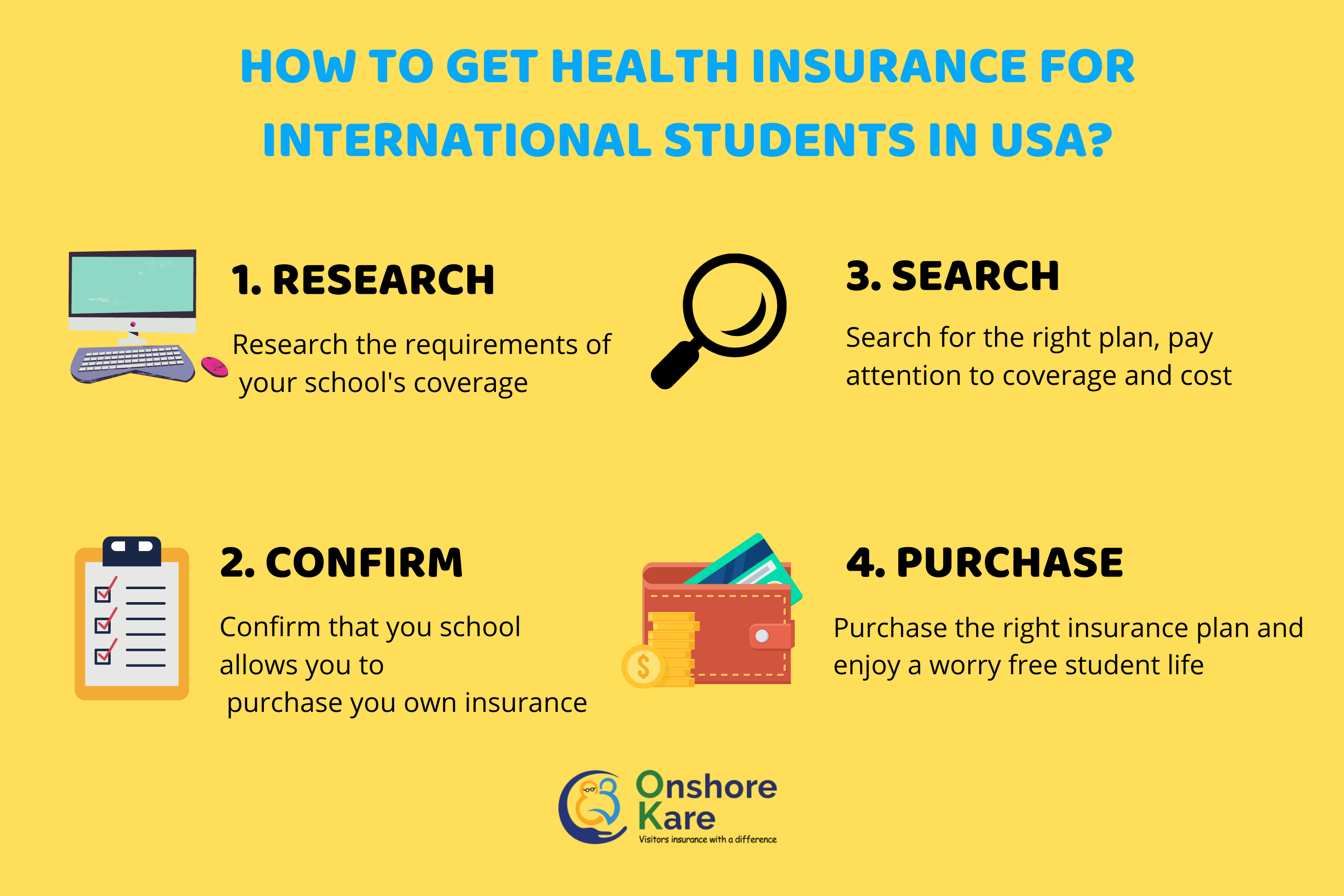
You must take the following steps to obtain student health insurance in the United States:
- Find out if the college, university, or school you attend in the US has a mandatory group health insurance programme.
- If they do, you must first determine whether they are included in the tuition bills or must be paid separately before proceeding with the payment process.
- Examine your eligibility for any mandated group health insurance plans that provide a voluntary exemption.
- If they do not have insurance, look for organizations or brokers that offer health insurance to international students studying in the United States.
- List the benefits you believe are important to you (including the waiver form), and compare them to the plans offered by the companies you’ve researched. Check to see if your dependents can be added to the plan if you intend to bring someone with you to the United States.
- Choose the best plan for you and proceed with the purchase.
Also Read: Parents visiting the USA? Here’s your checklist for medical & visitors insurance
What options do international students have for health insurance in the United States?
You should familiarise yourself with your options before selecting medical insurance for international students studying in the USA. Your main choices are:
Health Insurance from your home country
Although it is the least advantageous choice, it is probably the most affordable health insurance for foreign students in the USA. The process for filing claims would be problematic with these insurance plans.
Your university’s healthcare centre provides a comprehensive insurance plan
Many American institutions allow international applicants to enroll in a school-sponsored insurance plan, and on occasion, they do so as a requirement. Universities frequently offer two options: a Basic Plan and a Complete Plan. The latter covers all medical expenses, from major accidents to flu virus treatment. This insurance plan fully covers your university’s health centre. But these plans are extremely expensive.
Third-Party Insurance
Among all the options, this is one of the best health insurance for international students studying in the United States. Some private insurance companies, particularly for students, provide exceptionally good and reasonably priced insurance coverage.
The majority of international students in the United States prefer this insurance strategy. It covers nearly all of the country’s top universities. The Compass Silver plan, which is chosen by the majority of US students, costs only $31 per month.
What are the types of Health Insurance Options for international students in the United States?
When looking for international student health insurance options in the United States, you should also check the regulations of the institution where you are enrolled to see if they have any specific requirements. Here are the main types from which to choose:
Mandatory Group Plan
Some schools/colleges/universities in the United States have their own mandatory plans with predetermined coverage that international students must purchase.
The following are the main characteristics of school-based plans:
- They are typically added to your tuition bill and cost more than individual plans.
- They provide more comprehensive coverage, such as
- Pre-existing condition coverage
- Maternity coverage
- Mental health coverage
- Preventative medicine
Mandatory Group Plan with Waiver Option
Some schools/colleges/universities have a mandatory international student insurance plan with predetermined coverage for all students, but students can still opt out. This is subject to the student purchasing an adequate plan if he or she chooses to purchase health insurance other than the one provided by the school.
The waiver form is used by schools to determine whether the outside plan is adequate. This is a two-page document that contains a list of the benefits requirements that your medical insurance policy must meet or exceed. It require the signature of you and your insurance company.
Optional Plan
There are educational institutions in the United States that do not have mandatory plans with pre-determined coverage, so students are free to choose any plan they want.
If your school allows you to choose any plan you want, never choose the cheapest option. Choose the one providing the most services, b Instead, compare several plans to find the best medical insurance for F1 visa students in the United States.
What are the requirements for international students’ health insurance in the United States?
Schools that have a waiver form will require you to purchase insurance that meets the conditions listed below:
- Adequate Maximum Policy: Students are typically required to purchase a plan with a policy maximum of at least $50,000.
- Deductible which is relatively low: As part of their waiver requirements, schools frequently require a deductible limit per condition or per policy period, so that students’ out-of-pocket costs are as low as possible.
- Coverage for mental health: This requirement is included because universities want to ensure that their students are not only physically but also mentally healthy.
- Maternity insurance : Female students will need adequate maternity coverage, with at least 80% coverage in-network for prenatal, delivery, and post-natal care.
- Coverage for Pre-Existing Conditions : If you have a pre-existing condition, such as diabetes, you must include it in your insurance plan.
- Coverage for Repatriation of Remains : In the event that you die, coverage for repatriation of remains pays for your family to return your mortal remains to your home country.
What are the benefits of International Students’ Health Insurance?
Important Factors to Consider When Purchasing Student Medical Insurance
Accidental or Illness Medical Coverage for Students
Students are frequently required to purchase a plan that includes a minimum amount of medical coverage for accidents or illnesses by their schools and host countries.
Emergency Medical Evacuation
The cost of returning the student to their home country or the nation where the evacuation took place, as well as transportation costs incurred as a result of the evacuation. Coverage for an emergency medical evacuation to the nearest qualified medical facility.
Repatriation of remains
If a student dies as a result of a covered illness or injury while away from home, this benefit may cover the costs of transporting the student’s remains back home.
What international students should know about medical insurance in the United States?
1. Remember why international students require health insurance.
There are very real risks that must be considered before studying in the United States, regardless of your age, travel experience, or general health.
In a country like the United States, not having health insurance coverage can have long-term consequences for both your health and your bank account.
You will be treated in an emergency regardless of your student health insurance coverage in the United States. However, if you are uninsured, you will be responsible for all medical costs incurred.
2. Remember the terminology.
As you look for health insurance for international students in USA, it’s useful to know the definitions of a few key terms such as:
Claim: If an accident occurs, a claim is filed. This can be done by hand or online. This is usually accompanied by receipts, reports, and photos.
Premium: This is the amount you pay each month or every six months to have insurance.
Deductible: This is a set amount that you must pay before your insurance begins to pay if you have a problem. This can vary greatly and has an impact on your premiums, the higher your deductible, the lower your monthly costs will generally be. The deductible is the amount you must pay each year before insurance kicks in.
Co-Insurance: In addition to your deductible, your plan may include co-insurance payments, which are a percentage of what you’ll be charged after your deductible has been met or exceeded. This is usually expressed as a percentage, such as 10%.
Co-payment or co-pay: This is a set amount that you must pay the doctor when you receive services.
3.Accomplish the health insurance requirements for your visa.
Your international student health insurance needs will differ depending on whether you are a full-time student (J1 or F1). Check out this University of Chicago resource for more information on these various visa pathways.
The type of health insurance you need for studying in the United States depends on whether you have a J1 or an F1 visa.
For J1 Visa:
International students entering the United States on a J1 visa must have adequate health insurance that meets the requirements of the US Department of State, also known as the visa authorities. Currently, the J1 visa insurance requirements are as follows:
- At least $100,000 in medical benefits per accident or illness
- Repatriation of remains coverage amounting to $25,000
- Expenses associated with the exchange visitor’s emergency medical evacuation to his or her home country in the amount of $50,000
- A maximum deductible of $500 per accident or illness.
These requirements apply to your dependents as well, so if you are coming to the United States as a graduate student or researcher with your family, children or spouse, they will also require adequate health coverage.
For F1 Visa:
F1 visa holders are exempt from meeting government-mandated standards. They have less stringent health insurance requirements than J1 visa holders because they are not subject to US government oversight or requirements. These policies are usually set by the educational institution where the student is enrolled.
4.Understand what an international student’s health insurance typically covers.
There are numerous organisations eager to provide you with the type of coverage that you require. Medical insurance for international students in USA typically covers new illnesses or injuries But wellness or preventative care is usually not covered. Emergency doctor visits and lab orders, as well as emergency surgery is covered but checkups on a regular basis may not be covered.
Remember that in addition to the basic inclusions, additional coverage can frequently be purchased separately, such as dental or eye insurance. Furthermore, you may have to pay an additional fee if you want protection for an emergency evacuation (e.g., natural disasters, political upheavals, etc.) or repatriation of your remains if you die while studying in the United States (note that this coverage is required for J1 visa holders).
If you are coming to the United States to study and have a pre-existing condition or chronic illness, you should consider purchasing an insurance plan that covers your potential medical needs, such as prescription drugs. Nobody wants a stack of receipts from out-of-pocket expenses as a reminder of their trip to America.
5. Plan ahead of time to cover the cost of international students’ health insurance.
What is the average cost of insurance for international students in USA? In general, international student health insurance plans are very affordable. You must plan ahead not only to pay your monthly premium, but also to save for any unexpected out-of-pocket expenses, such as deductibles, co-insurance, or co-pays.
6. Other things to remember:
Don’t put it off. Plan your health insurance before arriving in the United States as an international student. While you may not require health insurance policy on the first day of your arrival, you will require it once the semester begins. To fill any gaps in your coverage as an F1 student, consider purchasing short-term health insurance for international students on OPT (Optional practical training)
Check out Health insurance for OPT Students to have a better understanding of OPT health insurance and how to buy medical insurance for OPT students.
Check your school’s requirements again.The institution where you are studying in the United States may have additional health insurance requirements, such as waivers. Check with your campus advisor or guidance counsellor to ensure that no documents are missing.
Make certain that you are still eligible. Some insurance companies will have specific eligibility requirements, such as requiring you to attend classes for a certain number of hours each week. If you can’t follow through on these, don’t pay for the insurance. It will not work
Best Health Insurance Plans in the United States for International Students
The following are the best health insurance plans for international students in the United States:
- Exchange Guard : COVID-19 coverage is provided.
- Patriot Exchange Program : COVID-19 coverage is provided.
- Student Secure : COVID-19 coverage is provided.
- Student Health Advantage : COVID-19 coverage is provided.
- Study USA : COVID-19 coverage is provided.
- Navigator Student : There is no COVID-19 coverage.
- Patriot America : There is no COVID-19 coverage.
How Should F1 Students Select the Best Health Insurance Plan?
When deciding on the best health insurance plan, keep the following factors in mind:
- Your health insurance’s sub- limit : This is the maximum amount that the plan will pay for a specific medical treatment and hospitalisation. This is expressed as a percentage or a price cap, and it determines how much of the medical bill is covered by the healthcare provider and how much you must pay yourself.
- Where you buy your health insurance : Foreign students may want to purchase a health insurance plan from a company in their home country at times. Purchasing your health insurance in the United States, however, is the easier option simply because claims are easier to process – hospitals can bill your treatment costs directly to your provider. If you purchased health insurance from a foreign company, you may have to pay for your treatment yourself first and then request reimbursement. This may not always occur.
- The requirements of the school. Consider the coverage, the policy maximum, and so on.
After-Graduation Health Insurance Options for International Students
If you plan to remain in the United States after graduation, the type of health insurance you require will be determined by your residency status.
If your status is changed to an H-1B Work Visa, you must have health insurance that complies with H-1B regulations. This means that you will have a short-term insurance plan at first, and you will be able to switch to a long-term plan after at least six months of residency on an H-1B visa. Employees in the United States are frequently provided with health insurance coverage by their employers.
Are Medications, Eye Exams, and Glasses Covered by International Student Insurance?
Yes, most insurance for international students medical cover prescripton drugs. If you are unsure, read the policy description or contact the insurance providers. Typically, with prescription medication, you pay for the medication up front and then file a claim for reimbursement with your insurer.
Basic plans may not cover eye exams, prescription eyeglasses, or contacts. Depending on your insurance provider, you can choose to have it covered by adding a little extra to your monthly premium.
Is Dependent Health Insurance Coverage Available?
Yes, some schools include health insurance for their students’ dependents (spouse and children). However, the costs will be much higher than for a single student in these cases.
If your school requires mandatory insurance without a waiver option, you will have no choice but to accept the insurance plan provided by the school, regardless of cost.
Frequently asked questions
Is it necessary to buy health insurance policy through the university?
You might be required by some colleges to enrol in their health insurance programme. Before putting the plan into action, check with your university.
What does the international students’ health insurance plan cover?
The type of insurance you have has an impact on the coverage. However, the fundamental coverage includes:
- Outpatient medical care, or care provided when hospitalisation is not required.
- When you have to stay in the hospital overnight for in-patient care.
- Urgent dental needs.
- Prescription medications.
- Procedures for diagnosing.
Is it necessary for foreign students to have health insurance in order to apply for an F1 visa?
The US Department of State states that F1 visa holders are not required to purchase health insurance.
Why isn’t it enough for me to use my US travel insurance?
Your US travel insurance is not the same as the international student insurance necessary for an F1 visa because it is short-term and does not offer the same level of protection.
In a nutshell, travel insurance protects you and your belongings during a trip (for example, the trip from your home country to the United States), whereas student health insurance covers you for any medical expenses you may incur while living and studying in the United States.
When should international students purchase health insurance?
Getting insurance as soon as you arrive in the United States is the best way to be covered.
What is the cost of health insurance for international students studying in the United States?
The length of study and the type of coverage are two factors that have an impact on how much health insurance will cost international students studying in the USA. A yearly insurance policy will typically cost between $500 and $1,000 USD.
Conclusion
You are now well equipped to find a policy and coverage that fits your goals, needs, and desires as a safety net during your time abroad, now that you understand the ins and outs of obtaining international student insurance in the United States. And once your international student medical insurance in the United States is in order, you can happily return to the more exciting aspects of planning your trip.